
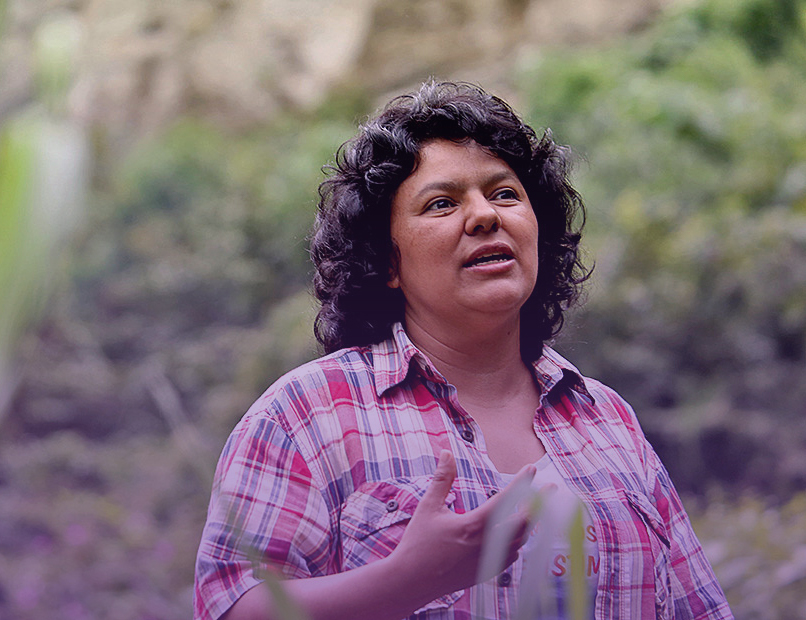
Who was Berta Cáceres and why was she murdered?
Berta Cáceres was an indigenous Lenca leader, environmental activist and co-founder of COPINH. She became known beyond Honduras’ borders for her opposition to extractive projects imposed on indigenous territories, particularly the Agua Zarca dam.
Immediately after the incident, there was consensus among human rights organisations that her murder was linked to her activism. The crime was interpreted as retaliation against a woman who challenged powerful business and political interests.
When and how did Berta Cáceres’ murder take place?
The murder took place in the early hours of 3 March 2016 at Berta Cáceres’ home in La Esperanza, Intibucá. Armed men broke into the house and shot her. Mexican activist Gustavo Castro, who was with her, survived the attack.
From the outset, the crime scene and the investigation raised questions. Family members and organisations denounced failures in witness protection and a state response that did not seem aimed at clarifying the facts quickly or thoroughly.
Who was convicted for the murder of Berta Cáceres?
Between 2018 and 2021, several perpetrators of the crime were convicted, including hitmen, former military personnel and employees or former employees of the DESA company, responsible for the Agua Zarca project.
In 2021, Roberto David Castillo, former manager of DESA, was also convicted as a co-perpetrator of the murder. However, as of 2022, the legal proceedings were not completely closed, which left doubts about the soundness of the convictions.
Were the masterminds behind the Berta Cáceres case identified?
As of 2022, the question of who masterminded the crime remains unanswered by the courts. Various journalistic investigations and public complaints have pointed to senior DESA executives and actors with economic and political influence.
Despite this evidence, there have been no firm convictions against those who allegedly made the key decisions, fuelling the perception that justice has only been served for those at the bottom of the criminal chain.
What was the connection between the crime and the Agua Zarca project?
The connection between the murder and the Agua Zarca hydroelectric project was pointed out from the early years. The project moved forward amid complaints of a lack of prior consultation and sustained community opposition.
Berta Cáceres was one of the leading voices against the dam and had reported threats and harassment. For national and international organisations, her murder could not be separated from the territorial conflict in Río Blanco.
Why was the Public Prosecutor’s investigation questioned?
The official investigation was strongly questioned by family members and social organisations. Initial hypotheses that attempted to disassociate the crime from Berta Cáceres’ activism were denounced, as were delays, omissions and a lack of transparency.
These irregularities generated mistrust and led to demands for independent mechanisms to investigate not only the crime itself, but also the context and power structures involved.
What role did the police and the army play?
There are reports of the presence of security forces in the conflict zone and their involvement in operations against Lenca communities that opposed the project.
Human rights organisations warned of surveillance, criminalisation and the use of force against COPINH members, which reinforced suspicions of a close relationship between the state and business interests.
How did the international community react to the case of Berta Cáceres?
The murder provoked a strong international reaction. Governments, multilateral organisations and human rights organisations demanded justice and protection for environmental defenders.
As a result of this pressure, several banks and international financiers announced their withdrawal from the Agua Zarca project, while the case became a global symbol of violence against defenders of the land.

